Time takes on a shapeshifting quality in the Motor Neuron Disease [MND] waiting room. There is no ordinary time. There are no regular clocks. No collect at the door, take-it-in-turn ticketing system. No screens with my name in a queue. No pulsating disc when my pizza is ready. No church bells or cuckoo clock.
Yes, there is day and night. Darkness and light. Which means we have screens and phones with time mapped according to our calendar and hour system based on our measurement of solar and lunar cycles.
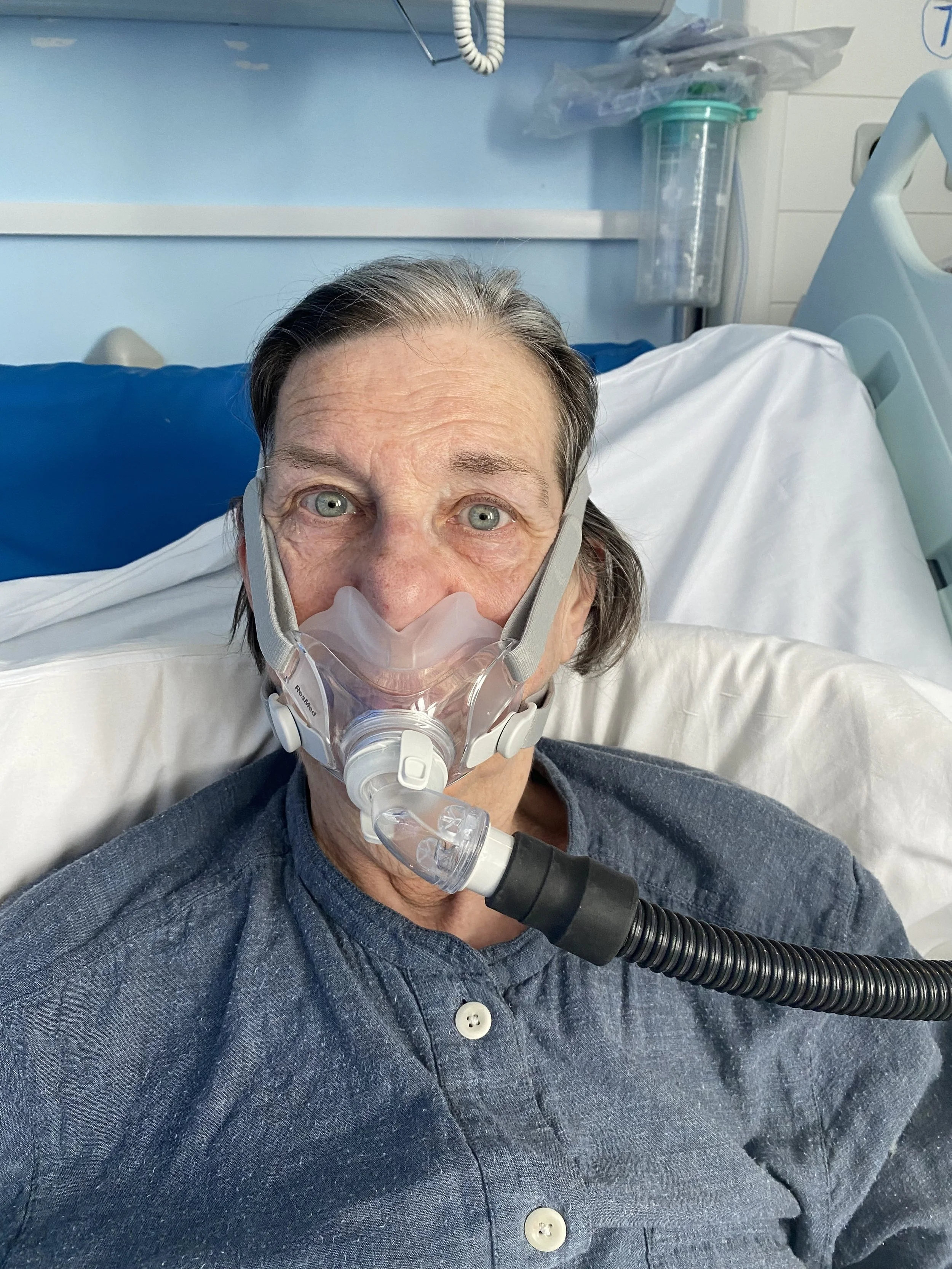
But time in the waiting room can speed up to a scary level: when I’ve been off the mask and ventilator and am stumbling - with help - to get back to my lifeline. Panicking that my body won’t cope. Then that respite when my lungs are filled and time settles into a breathing rhythm and I’m back in a physical comfort zone, albeit with my bridle on!
Time can also slow to an indefinable quality. When I am awake in the night, alone, still half in one of my cinematic, hyper-real dreams and contemplating what lies ahead and how long I have left.
Day after Groundhog Day is the same apart from registering new physical ailments or dysfunctions - declining grip strength, muscle twitching, cramping, stiffness, joint ache, digestion issues. But I am not dealing with pain, just discomfort.
An incomparable element of my previous ‘time-life’ was spent structuring living with concepts like ‘next’ - next week, next month, next year. Next time.... The calendar is full of time specific events – Christmas, birthdays, visits. But now there is always the message written in hidden ink - will I be here for the next one? Is this the last one?
So there can be no confidence in measuring the future. No planning. No ambitions. Just wondering how long I have before it all gets so bad physically that I will want to quit.
It is not just about navel gazing on my personal situation - my time in the MND waiting room has been about looking at humanity in an age of crisis we don’t fully believe in or understand.
Simon McBurney of Complicité, has carefully and comprehensively articulated some of the problems we are facing, as part of his ‘Figures in Extinction’ performance. “We live in an age of disconnection – from the natural world and one another. Can we name what we’re losing? What does it mean to bear witness to a destruction we both cause and endure?”
There is an ever-growing fear and confusion in the world, orchestrated by the endless bad news on commercial media and social and this Interrelationship is not being addressed or dealt with at local, national, or global levels.
So I am confronting a mixture of my time alongside a time for humanity and our species. My personal departure lies ahead of an accumulation of crises I am watching emerge and develop - war, plague, genocide, nuclear destruction, famine, viral chaos, AI takeover, plus the world’s plunge into multidimensional eco and climate crises.
But time itself is ever more complicated. Maybe we are beginning now to rethink and reimagine time as something much larger and powerful - its micro and macro cycles that we have ignored and failed to respect but just taken for granted.
I have been inspired by Joanna Macy, [May 1929-July 2025], eco-philosopher, Buddhist scholar, and activist who co-authored the book Active Hope: How to Face the Mess We're in Without Going Crazy, with Chris Johnstone. The concept of "Active Hope" is a central part of Macy's larger body of work, known as the Work That Reconnects. It is a practice of intentionally engaging with the world's ecological and social crises rather than being paralyzed by despair or cynicism.
But I will start from my neurons not firing properly in a complex environment of mind and physical systems. Then I can consider ‘Mini me’ in the body of the greater universe.
MOTOR NEURONE DISEASE
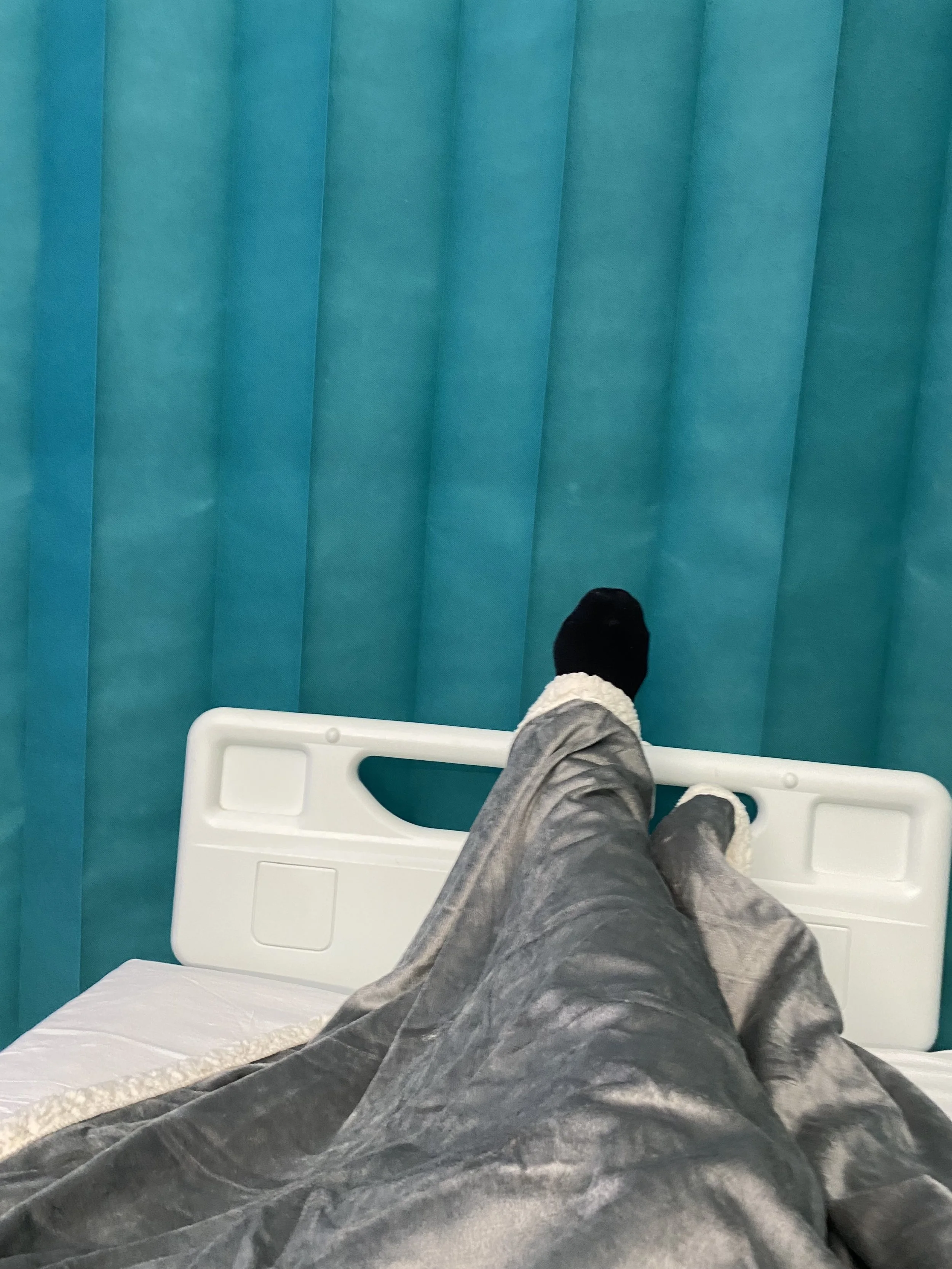
I have been in The Motor Neuron Waiting Room for well over a year: it is crammed with bags and boxes - of memories, documents, photographs, as well as medication and equipment to help me and my disintegrating body.
I call it this because it is a completely different space to live in - from my previously ageing but functioning body’s living space. From the day I was given a diagnosis of a form of Motor Neurone Disease [MND] I needed to confront my actual future - what would happen to my body and mind, when and how death would happen and most importantly what would happen when I die? There are no clear or easy answers even though I spend a lot of time speculating on my physical disability and all the consequences.
The initial signs of my Motor Neurone Disease (MND) were muscle weakness in my upper arms, so reaching up to lift a dish or jar down from a high shelf caused me to ask the question - is this age related? Does this happen in your seventies? It was subtle at first and I pushed it aside. The big alarm bell symptom was when halfway along a length in the swimming pool I suddenly was devoid of air in my lungs. I scrabbled to the side of the pool then hand over hand on the gutter made my way to the shallow end where I gasped my way back to a regular breathing level. This was not subtle at all. It was scary.
In brief it then took 18 months for a diagnosis, during which time I experienced a very gradual exacerbation of symptoms, especially breathing but also weakened muscles. Frustrated by my GP, I reluctantly turned to private healthcare: they focused on my breathing, not the other symptoms, and found no lung cancer. This left me in a lacuna of ten percent relief plus ninety percent wondering what was going wrong. I suspected my breathing symptoms were related to Long Covid but became also aware that incrementally I was experiencing a loss of muscle control. In addition, I was having turbulent nights with virtually conscious drama dreams accompanied at times by mini hallucinations. Apparently, this was due to low oxygen levels and high carbon dioxide levels.
By April 2024 we were getting uneasy and anxious about the symptoms: my daughter Phoebe, despite the pressures of work and small children, undertook to research and ring round speaking to doctors and consultants. Finally in May, thanks to her doctor friend, I saw a private respiratory consultant who very generously liaised with the Royal Free because of my risky C02 levels. That evening, I was admitted via A&E and put on a ventilator pushing a normal mix of air into my lungs. A vivid memory of that first night of ‘real’ sleep still stays with me. Following neurological tests, I got a diagnosis within 2-3 days.
Nobody has been able to explain much except that the malfunctioning neurons affected my diaphragm and so I ceased to be able to fill my lungs. Two hospitals have mainly monitored my symptoms. A very sympathetic young doctor whose mother also has MND gave me the very good advice to not go looking online as I would end up down a bunch of rabbit holes, none of which might be really relevant as MND is a highly individualistic condition.
I still experience endless dreams with me as a whole body again; breathing, moving, independent, no need for mask or wheelchair, my hands working, no aching joints, no claw hands, no swirling gut. Then I wake and emerge from the tendrils of these dreams into my dysfunctional body and slowly absorb the reality of another uber dependent day.
I carve another notch in my time stick and go into neutral gear, savouring every hour and using my time to learn and be open.
BREATHING HAS INCREASED MY AWARENESS OF NATURE
Week by week I have become more dependent on my ventilator blowing air [regular air, not oxygen] into my lungs. This lets me breathe. I have become very breathing conscious - how my body really struggles and my brain gets fearful when I don’t have air - and I now reflect on how much I took my lungs for granted and how little effort I made to understand our co-dependency with the world of plants and growing nature - my understanding of science at school was deplorable and has not improved much.
I felt grateful when I came across a super simple description of how it all works from David Abram, in his foreword to Joanna Macy’s book: A Wild love for this world: “The oxygen we need to breathe is precisely what all the green plants around us are breathing out. So what the plants breathe out, all of us are breathing in. And then what we breathe out is just what all those plants need to breathe in.” This has brought home to me “how mutually entangled these two activities are.”
Sitting in the waiting room, breathing through the machine, I have developed an intense awareness of the seasons - spending time staring out through the windows at the changes in the trees and plants. Watching the naked, leafless branches sway in the gusts of wind and contemplating the complex structure of trees and the plants around them. Hours are spent watching the visual rhythm of the leaves in their endless shades of green - from lime to sombre grey-green, both top side and underside, touched by light or deepened by shade creating ever changing shapes and animated by irregular bursts of wind.
In the grey light of February, inside the house, my daughter’s birth plant of a Clivia [a South African native, a Natal or bush lily] now 38 years old since it was gifted, began emerging from its winter dormancy. Cream heads with multiple flowers each tightly packed into its own envelope began rising from base level into a sturdy stem, bypassing the tough leaves they began to stand tall in anticipation of the drama about to be presented. Each head was a gift about to be transformed as flower by flower pushed up into to the light. For 3-4 weeks, each year, the original clivia, surrounded by its offspring, gradually bloomed into a gleaming orange and yellow, end of winter fashion. The colours, the tones, the shape, the confidence in their actions gave me the chance each day to stare and muse on the power and complexity of their performance. Too cold and early for pollen seekers, these plants were there to be marvelled at. But then gently, bit by bit, the next stage began: the faded flowers tumbled from their stalks, leaving a red seed pod and leaves. And so, the cycle continued... But for me there was an acute realisation that I would not marvel at this drama again, that I would not be here the following February. But where would I - the individual ego, the personal identity - be? In what form? What shape?
Can we know? No.
If you don’t know what happens at death there is a fearfulness - aware of all the possible stories from reincarnation to the divisive heaven/ hell narrative as we desperately look for some sort of version that camouflages the fear. Perhaps moving to a hinterland [from German, from hinter ‘behind’ + Land ‘land’] - an area looking something like the land and sea we are familiar with but lying beyond what is visible or known. That is a version of crossing a boundary but not changing from our human form.
There are many different faith stories but these are all from a human perspective, involving gods or an afterlife. None of these offer me any calm perspective. Having spent over a year in the waiting room, watching or reading on screen while an endless parade of power and profit driven men have directed abhorrent actions against humanity, I have been searching for other understandings and outlooks on our human life cycles.
I feel very grateful to have encountered a number of writers who have graced me with an utterly different perspective on death and dying - in fact, contributed to an entire reset of my life perspective.
A long time ago - maybe through way too much C of E chapel time at boarding school - I turned away from the entire Christian culture and settled into a mindset of no religion or faith. This lasted for decades. Things changed when I read ‘Braiding Sweetgrass’ by Robin Wall Kimmerer, an indigenous botanist. Her opening chapter offers a very different creation story to the Christian one which I always found too binary in its altercation between punishment and reward. With women relegated to a status of guilt and shame. With human judgment at the centre.
Kimmerer offered me a sense of total integration with nature, with a woman at the centre of the universe. An acceptance of a scale of non-human power.
I have become calm and unafraid of the moment of transition from human life to being ‘entangled’ in a universal consciousness. This leaves me free from fear and dread of death to focus on the pain of parting from the people I love.
It has been this last year as I have contemplated death that the writers and thinkers in this sphere have opened my mind and helped me with a positive approach to my imminent moment of change.
END OF LIFE CHAPTER
Death, dying, departure, disintegration: the big D has been an ever-present companion for me in the waiting room. But despite a lot of reflection and contemplation and the odd bit of discussion I’m no closer to fathoming what it really means.
I can’t control it! Images come to me: the grim reaper in black & white mediaeval-style. Or the very tidy Ophelia lying submerged in the water surrounded by flowers. Or if I allow it - images of grim accidents or killings appearing on the screen. All this is a form of cultural Interpretation of death, but it avoids the bigger picture and the bigger meaning.
I drew a lot on what I’d learned from the death project I worked on with my partner, photographer and video maker Barry Lewis. He had made an initial short version called ‘What do you think happens when you die?’ Conducting straight to camera interviews with a wide range of people of all faiths, ages, ethnicities and including scientists, anaesthetists, comedians, he asked the same question. All the answers were different: there is no absolute explanation- no one knows for sure even if they carry their convictions held high.
We took the idea to the Wellcome Institute who were keen to develop a national programme of conversations around death and its culture, using the film and its varied views as a starting point. I learned about Death Doulas [who provide emotional, practical and spiritual support to those approaching the end of life] and various regional associations whose aim was to encourage a more open attitude to death as well as individuals with near death experiences and campaigns to make death less taboo and more of a social topic. It was an ambitious programme, outside of the media and although we tried to be realistic about the budget it kept growing in price. When the Wellcome shifted its funding priorities and declined to go ahead we both felt it was the right decision, although we knew with certainty that the conversations around death have never been so significant.
Sherwin B Nuland, medical professional, draws attention to how there is a vast literature on death and dying – including changes over centuries from how concepts such as Ars moriendi, the art of dying, evolved into ‘the beautiful death, the correct way to die’. He describes how this literature is intended to help people deal with the emotional trauma involved in the process and its aftermath - the details of physical deterioration have for the most part been subdued. “In recent generations,” he explains, “we have created the method of modern dying. Modern dying takes place in the modern hospital, where it can be hidden, cleansed of its organic blight and finally packaged for modern burial.” In complete incongruity to the many eco-philosophers now amplifying their beliefs, Nuland claims with medical certainty: “We can now deny the power not only of death but of nature itself.”
I have formulated a sequence that makes sense to me, given that MND is such a hard disease to decipher and because it’s a cul de sac - there is no way out, no respite treatment and as each symptom aggravates so do the side effects. The Body & Mind as an integrated entity has never seemed so real and time connected.
So, my sequence starts with disintegration (stronger than decline) with central physical functions such as my diaphragm messed up by the correct neurons not firing, causing major breathing problems upstairs in the lungs, and major expulsion problems downstairs in the gut. All the symptoms are dealt with at some level, but disintegration is a process that doesn’t stand still.
As this gets harder to deal with, so I begin to consider my departure - a slow process involving tidying up my life (in both the digital and the real world).
Departure means confronting the decision I will eventually make to come off the ventilator, increase the morphine and doze, drift and sleep my way through the dying stage to the final stage when my mind and body cease to function.
Death is the full stop.
But none of us know what that means.
My time in the waiting room has witnessed the bumpy ride the Assisted Dying legislation has had - and is having, with no real logic in the resistance. I’m glad that I am not in a state of utter dependence on it.
I feel very fortunate to have come across writers and thinkers who offer me a very different approach to my full stop. In a phrase, humans are fully integrated with the bigger picture of nature.
This is all very different from the human-based interpretation of death through faith, religion, divinity - and above all a type of control through our minds and our imaginations set in a rule based framework - being promised an afterlife, an eternal life: Life-ever-after is not a possible option outside of the construction of faith and powerful male god figures.
Nature is and has been largely left out of these stories.
I am not joining a cult or a doctrine or an alternative movement with these thoughts and words. I am finding consolation in the growing body of thinking that at some level could be named natural philosophy - the name given to science early on when structured thinking and experimentation developed and began to separate itself from religion.
This research and greater scientific understanding of human life and death inspires me to think calmly about my death. Not, as I have heard from scientists, death as a case of just switching off electricity and shutting down me like a computer, pushing me into a state of nothingness. I also disregard the promise of the soul being reincarnated into another human form in an ongoing circle. And the blasé phrases for dying - conk out, bite the dust, kick the bucket, go belly-up, peg out, pop off, drop off, give up the ghost - can only reflect the sad hardships of a life not valued or one in which faith and religion struggled to play a part.
Rupert Sheldrake’s research-led vision of an entanglement with this universe with consciousness intrigued me and made sense. A New Science of Life is a book about how life-forms interpenetrate and change each other continuously.
Robin Wall Kimmerer’s more recent work in Emergence magazine involves the visit to the research site of an ancient forest and exposes to me the science and biology I wish I had been offered at school - a greater connection to my life and existence within a staggeringly large time cycle. As she points out: “We humans emerge, walk around as if we were one thing, willingly oblivious to our true nature, and then we dissolve in order to emerge again in a wholly different form.”
Emergence magazine has been a source for me of bigger picture thinking: it tackles essential topics, often philosophical as well as political, but approaches them in such a way as to challenge centuries old thinking and bring a new very different way of comprehension, integrated across science and the humanities.
For example, their coverage of Time asks big questions;
Separated from the fabric of the cosmos, the vast mystery of Time has been distilled into a tool of control. But what kind of Time listens and moves in tune with the Earth; travels not in a straight line, but in a circle? Journeying through its many landscapes—deep time, geological time, kinship time, ancestral time, and sacramental time.
Their Big Question: If we can recognize a different kind of Time, can we come to dwell within it?
My response - Or do we die within it?
Or do we take out the word die and opt for a much more powerful idea of Entering the Circle of Time?
Religious terms for "die" often focus on the transition of the soul or spirit rather than the cessation of physical life. Common phrases include "passed away," "departed," "gone to be with the Lord," or "entered eternal rest," all emphasizing a spiritual journey or state of being.
My shift towards a respect for nature began, and importantly continues, with Robin Wall Kimmerer. She has opened my senses to how we as humans (especially with a western mindset) regard nature as an entity to be controlled, plundered, exploited but respected in the form of a garden centre! The image of the Ha-ha [dividing man and cattle] comes to mind where the landowner deliberately structured a hidden break between the manicured garden and the animals to give the illusion of uninterrupted views across the Arcadian pastoral landscape.
Our disconnectedness with nature has continued to grow: a Guardian article [09/08/2025] focuses on a new study that has found that people’s connection to nature has declined by more than 60% since 1800. The study by Miles Richardson, a professor of nature connectedness, tracks the loss of nature from people’s lives over 220 years by using data on urbanization, the loss of wildlife in neighbourhoods and, crucially, parents no longer passing on engagement with nature to their children. “Nature connectedness is now accepted as a key root cause of the environmental crisis,” said Richardson, meaning that our urban lives overwhelm our care and concern for nature and block our ambition to change our climate crisis. Even though humanity is a small part of what nature means and envelops.
Can this mean we do not know how to respond to the ever-expanding growth and terrifying aspects of climate and ecological crisis? That we fail to understand the interconnected and multidimensional nature of the crisis? The growing number of activists and visionary writers have to battle denial and offer us positive ways to play our part against political and corporate power – a leading figure such as Joanna Macy who offers sense and sensibility in a structured fashion for us to confront the world changes we are facing.
I am very grateful to Emergence magazine for their illuminations. Maybe without time in the MND waiting room I would not have responded and engaged with their stories, their vision and their perspective. They have certainly liberated my mind and made it possible to think in a completely different way about post dying and what happens after the full stop.
It has been helpful to regard my body not as human flesh but as biomass, as a positive aspect of rotting or breaking down to become an intrinsic contribution to nature’s processes. For example, author Sophie Strand uses her imagination to feel herself as part of the more-than-human world—as river, hummingbird, and mycelial network. Opening herself up to a “supracellular” state, she practices letting her mind leak beyond the bounds of individual consciousness and through the threads of relation that she shares with her ecosystem to experience being not a siloed self, but a web of interconnectivity. Her article in Emergence is inspirational in how she pushes forward to a new level of existing and being active within a different framework.
Actually, equating death with a full stop is not a bad route: above all, I can now accept and relax into being intertwined with the universal consciousness and energy in cycles of time we humans do not appreciate. Wall Kimmerer talks a lot about the activity of atoms and I now have a series of images of me as an atom coasting on the wind, underground forming foundational strength with the magical bonding of fungi (thank you Merlin Sheldrake) or in the ocean building a sublime and supernatural wave crest, or even part of a delicate, unique snowflake changing according to the atmospheric conditions. The endless, intricate and flabbergasting design details of nature give me a rich imaginative pathway. This is not ‘life’ after death nor is it reincarnation as in the rebirth of a soul in another body. When I die, I am no longer human - I dissolve into an infinite cycle of energy and time, leaving behind me the reality of what the human species regard as their world to destroy.
Joanna Macy led an activist’s life with a graceful, positive view of how humanity should relate to nature and the world around us. More respect. Less exploitation.
“You are not a separate being. You belong to the living body of Earth. You are the Earth, looking up at the stars. You are the Earth, becoming conscious of itself.”
PARTING
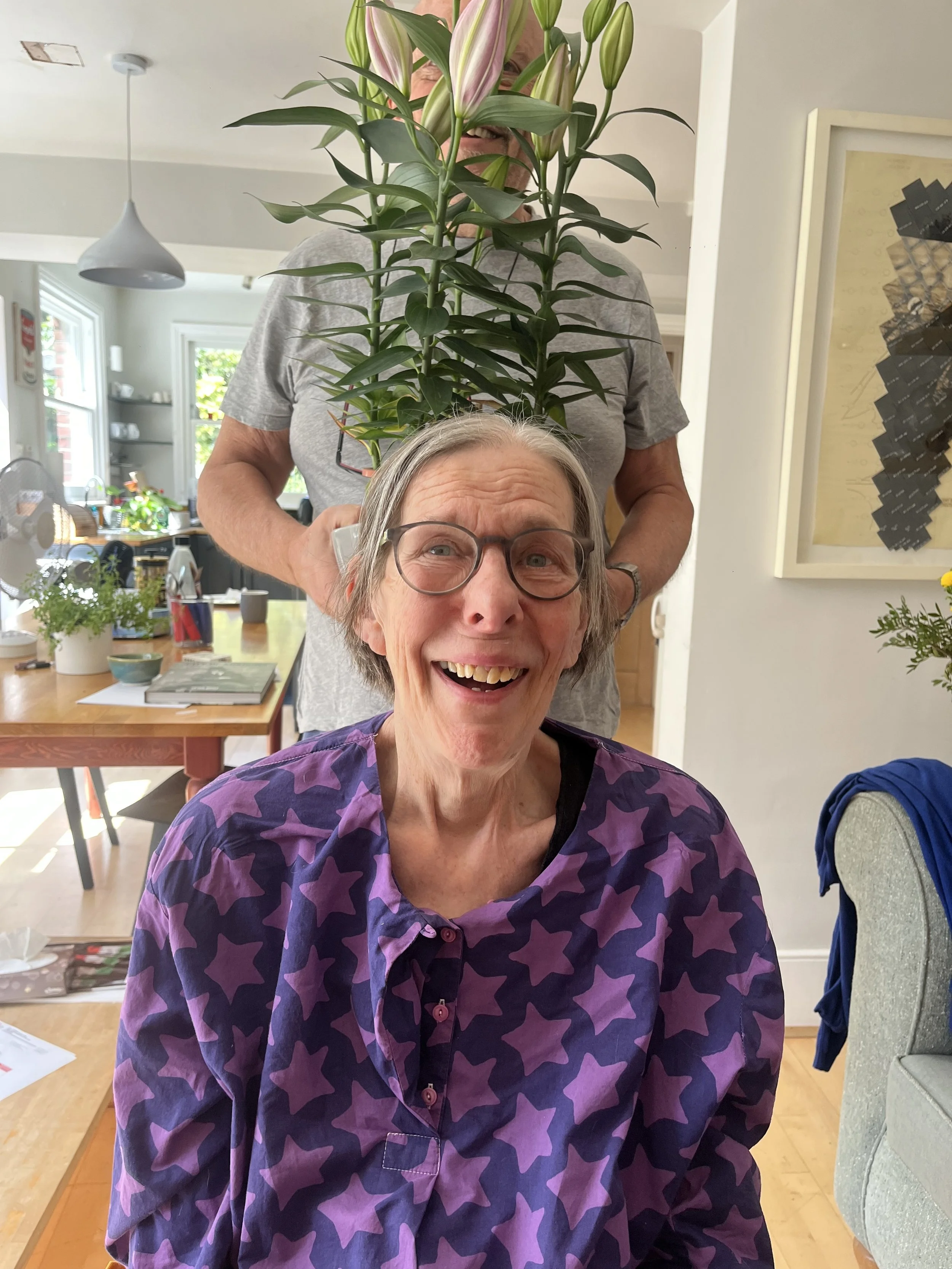
In my time in the waiting room - I have met myself full on. The harsh side of death - as opposed to the unknowingness of what happens - is parting from loved ones. From family and friends.
The other side of contemplating my existence as an atom coasting on a cloud - or a grain of sand on a beach somewhere- is to lament my loss of partner, family and friends. Not things. Not places. The windows of the MND waiting room have got gradually more blurred, so all the stuff on my bucket list have receded, faded into a reality I feel far less connected to.
My partner Barry Lewis and I met over 40 years ago: mutually we recognised qualities almost immediately, and the chemistry between us formed a bond that connected and committed us to a life journey together. He was a science teacher before becoming a photographer and he has taught me all the science I think I know - and the chemistry between us has continued to strengthen as we’ve grown old. We have had a glorious family life - as a very blended stepfamily, with his two daughters, Clare and Anna, and with our daughter, Phoebe, and our son, Jack. With six grandchildren we have shared endless memories and experiences, shaped by vivid discussions and harmonised by non-stop banter and jokes.
As our new MND reality abruptly arrived, first with my symptoms of illness, then with diagnosis, I have cherished how our love has deepened, from leading independent lives welded with shared intimacy, and changed from doing things together to a scary level of dependency.
For him it has been watching me slowly retreat and disappear - I can’t talk much, walk, hear, breathe or feed myself. We can no longer share things as we used to, but in place is a generosity of spirit that moves me on a daily basis.
Tears were triggered in the first months by the strangest things that engulfed me with emotions impossible to describe - for me it was the sight of communal joy or anguish - the Lionesses winning - something like football that I couldn’t usually even imagine doing.
I remember we both decided to break away from contemporary reality and, having just watched Civil War, we turned to Toy Story 4. We both sobbed through the last twenty minutes when Woody is deciding to part from his tribe, from his friends, for an unknown life. We both shared that moment of toys departing as it resonated deeply with what we we’re approaching.
Time has played a part in our tears: at first it was the shock of the unknown, the sheer fear of what is ahead. We can’t find words to give shape to the flood of emotions - for all of us it brings into sharp focus their own mortality. But as months passed, we have each adjusted and adapted to new patterns of living and witnessing my weekly decline, and all of each in our own way are recognising how, as the body deteriorates, death is an acceptable outcome.
We have been given time to reassess each other, to explore our memories, to prepare for life after me, to cry together, to debate, to sit in the garden holding hands and listening to birds and watching the plants journey through the seasons.
MY heart - the pulsing mechanism - is filled to the brim with precious feelings for my partner Barry and my immediate family - children and grandchildren.
The best way I can describe it is to use the ‘more’ phrase of when something is more rich and powerful than it seems. When I am with my partner or my children it is as though there is an additional element of quantity and quality that has been developed over time and especially intensified in the waiting room period. In other words, with each member, one plus one equals not two but three. It is so much more than a relationship of two [and that definitely does not include any form of AI!].
There is something we have built between us, that forms a precious and unique entity, a quality, a legacy that will endure and, I hope, strengthen the survivor. But we have had time. Time to share memories. Time to discover new dimensions of admiration, honesty, truth, trust. This is accentuated when children become parents and we become grandparents and the family dynamic blooms into a richer and multi layered experience - with its ups and downs of course! I have especially treasured time with my daughter Phoebe, when we have talked about the bond between us as mother and daughter and her own parenting of a girl and a boy. Tears flow but we feel closer than ever.
As I become more dependent I find myself watching the pure goodness and generosity of my family – and especially – my partner and my son Jack, adjusting each day to my vulnerability as well as the pain of my daughters, who whether through location, job juggling and parenting cannot help as much they wish to. Each individual has responded in their own way and my heart overflows with love and gratefulness. We have all travelled a long way together. And the only anxiety that ferments inside me is that in the event of any one of the hovering crises I would be an additional burden to their lives and their survival. So, the notion of slip-sliding away before too long acts as a consolation – even, dare I say, a comfort.
Thanks to my close friends who have been so supportive and generous with their time and care. They often don't know what to say or, sitting next to me in my Cul de sac, have to face their own mortality. And we all of us need a better conversation about living and dying. Not to look the other way, in denial, but to share our thoughts, our fears and our feelings.
Because of the waiting room [and my waiting room time, unlike Stephen Hawkins’ who managed a parallel life to his 55 years of MND, has been relatively short at the end of a long life], as a family and tight circle of friends, including my exceptional carers and osteopaths, Cerys, Dionne, Sibyl and Sarah, we have had time to say goodbye, to talk things through, to remember. In this pre-dying period, I am still fully conscious and deeply curious and am grateful that I can manage to write on my laptop, using the middle finger of my left hand! Of course I have regrets from both the past and the future – things I avoided doing, family things I will miss. A key regret is being ill and not having been able to pursue my white woman’s work; to be active and help white people have the conversations they shy away from and support the many black activists with their work, especially in the current climate of division and hostility.
It is not easy right now to imagine what we desire as real, positive change across human activity, but I have encountered enough good, strong, creative people – in books, on screen, in work and in life - that I allow myself to believe that caring humanity will find its way forward.
Hope can become a dangerously bland word: I don’t know and have no idea what to do about the mayhem we are in but if I fill the space with hoping, then maybe something will happen. Joanna Macey has addressed this slightly pointless thinking with the more dynamic perspective of ‘active hope’:
“Active hope involves identifying the outcomes we hope for and then playing a role in moving towards them. We don’t wait until we are sure of success. We don’t limit our choices to the outcomes that seem likely. Instead, we focus on what we truly, deeply long for, and then we proceed to take determined steps in that direction.”
Macey, Joanna; Johnstone, Chris. Active Hope (revised): How to Face the Mess We’re in with Unexpected Resilience and Creative Power.
Farewell. And good luck to humanity and its capacity for change.
Hannah Charlton
For more information on Motor Neurone Disease visit the MND Association